Thursday, 15 January 2015

Certificate Research


The 'U' symbol stands for 'Universal'. A 'U' film is suitable for audiences age four years and over. However, it is impossible to predict what may upset a child especially at this lower end of the category range.

Universal have said they rate films and videos aimed at very young viewers, such as 'Chuggington' or 'Tinga Tinga Tales'. Films and videos with this BBFFC insight raise no significant issues in terms of discrimination, drugs, imitable behaviour, language, nudity, sex, threat or violence.

In some films, characters may be seen kissing or cuddling and there may be references to sexual
behaviour. However, there would be no overt focus on sexual behaviour, language or innuendo. Violence is generally very mild. A 'U' film may include a brief film scene or moments where characters are placed in danger. However, moments of emotional stress or threat will be quickly resolved and the outcome will be reassuring. There may also be brief scary scenes and moments where the characters are placed in danger. As with violence, these scenes will be balanced by reassuring elements, such as comic interludes or music. The antagonist may carry or use weapons - but there would be no emphasis on these. A child or protagonist characters are unlikely to use any kind of weapon outside.


'PG' stands for Parental Guidance. This means a film is suitable for general viewing, but some scenes may be unsuitable for young children. A PG film shouldn't unsettle a child age around eight or older. Parents should also consider whether the content may upset younger, or more sensitive, children. Some films are given a PG certificate but have not been made with a young audience in mind. A recent example of a film mostly enjoyed by grown ups but passed PG would be 'Saving Mr. Banks'. However, the certificate means that any issues in the work are appropriate for the majority of the age
group and nothing should upset a child over the age of eight.

A PG film would not contain any theme which is inappropriate for a child. PG works explore challenging issues such as bullying, bereavement or racism. There may be mild language such as 'shit' or 'son of a bitch' in a PG film, but the context and delivery are always important. For example, if the language is used aggressively or if there is a great deal of bad language, a work may be passed at a higher category.

There are unlikely to be any sex references unless they are undetailed and infrequent. If a child is unlikely to understand a reference, it may be allowed as a PG. Comedy can also be used to lessen the impact of sex references and innuendos.


Films classified as 12A and video works classified 12 contain material that is not generally suitable for children under the age of 12. No-one younger than 12 may see a 12A film in a cinema unless accompanied by an adult. The difference between a 12 and a 12A is that a 12A requires an adult to accompany any child which is under 12 years old. This is enforced by cinema staff as a cinema may loose it's license if an adult accompaniment is not enforced.  The BBFC guidelines state that strong language (e.g. f***) may be passed at 12 or 12A, depending on the manner in which it is used, who is using the language, it's frequency and any special contextual justification. In 12A films, sex may be briefly and discreetly portrayed at 12A or 12. Verbal sex references shouldn't go beyond what is suitable for young teenagers. Comedy can again, lessen the impact of some moderate sex references or innuendo but frequent crude sex references are unlikely to be acceptable in this category of film. Some horror films can be passed as a 12 or 12A.Physical and Psychological threat is permitted in this category as long as horror sequences are not too frequent or sustained and the overall tone is not disturbing.


For a film rated 15, anyone who is under the age of 15 cannot be allowed to see a 15 film at the cinema or buy a 15 rated video. No theme is prohibited, provided the treatment is appropriate for 15 year olds. In a 15 rated film, you might see strong violence, frequent strong language, portrayals of sexual activity, strong verbal references to sex, sexual nudity, brief scenes of sexual violence or verbal references to sexual violence, discriminatory language or behaviour and drug taking.
In any film passed for this category, there could potentially be a great deal of strong language. Occasionally there may be uses of the strongest terms (e.g.. c***), depending on the manner in which it is used. There may also be racist, homophobic or other discriminatory language, and the work could explore themes relating to this. However, at 15 the work must not endorse discriminatory language or behaviour. At 15, there can be strong threat and horror as long as there is no sustained focus on sadistic or sexualised threat. In these films, drug taking may be shown but the work as a whole must not promote or encourage drug misuse. The misuse of easily accessible and highly dangerous substances like aerosols or solvents is unlikely to be acceptable at 15. There can also be detailed verbal references to sexual violence, for example, descriptions of rape or sexual assault in a courtroom scene or in victim testimony, but any portrayal depiction of sexual violence must be discreet and justified by context.


Films rated 18 are for adults. No-one under the age of 18 is allowed to see an 18 film at the cinema or buy/rent one either. No 18 rated works are suitable for children at all. No theme is prohibited at all at 18. Adults are free to choose their own entertainment provided the material is not illegal or potentially harmful. In an 18 film you will see very strong violence, frequent strong language (e.g. f***) or very strong language (e.g. c***), strong portrayals of sexual activity, scenes of sexual violence, strong horror, strong blood and gore, real sex (in some circumstances) and discriminatory language and behaviour. At 18, there can be strong and detailed portrayals of sex, including full nudity. There are no constraints on nudity in a non-sexual or educational context. Very strong, crude and explicit sex references are permitted to this category. Horror films can also contain very strong horror,  gore or sustained threat. You can also see drug taking but the work as a whole must not promote or encourage drug misuse.


For our chosen film, it would be a 12A as it would be suitable for children to go and watch without the presence of an adult. It would also be suitable because our chosen film is not going to be extremely scary and scarring to children. We have decided to make our film 12A because we do not have frequent horror sequences and the tone is not overly disturbing. I think it does not fall into a PG rating because we think it is inappropriate for a child to watch as it explores challenging issues such as murder, but does not fit into the 15 rating because we do not use strong theme of threat or horror and only keep it discreet when it is involved.


Wednesday, 14 January 2015

Title Sequence Comparison


In conclusion, both clips use very different approaches to title sequences. For example, 'The Shining' uses a car driving along a road which is immediately more engaging to the audience whereas 'Signs' is very basic and just has a blue background bringing up the cast members and people involved in the film. My preferred type of clip would be 'The Shining' as I find it more engaging and it is something to keep you interested while waiting for the film to start. The style we are trying to achieve in our title sequence is similar to The Shining as we want it to be engaging to an audience and want to reflect the mystery of Gothic Horror. By using this type of title sequence, we can engage the audiences fear early on in the film and intrigue them into the rest of the story.


Tuesday, 13 January 2015

Title Sequence Analysis - The Shining (1980)

 
For the first of our clips, my group has chosen to do 'The Shining' which starts straight away with music - a trumpet - playing at the very beginning of the clip. At about 1 minute and 8 seconds into the title sequence, the writing with 'A Stanley Kubrick Film' comes up in bright blue capitals which would show that he is a well known director. 4 seconds later (1:12), it comes up with 'Jack Nicholson' which, again, is in large, bright blue coloured capitals, this shows that he is a top billing, well known actor. It also comes up at 1:18 with the name 'Shelley Duvall' as she would become one of the main characters in the film along with Jack Nicholson. After having the title sequence on for 1 minute 25 seconds, it comes up with 'The Shining' which was in large writing as it was the title of the film. 3 seconds later, it shows on the screen 'featuring... Danny Lloyd', this suggest that they aren't top billing actors but still are main characters within the film. After this, at 1:35 it comes up with 'Scatman Crothers', 1:40 'Barry Nelson', 1:44 'Philip Stone', 1:51 'Joe Turkel', 1:55 'Anne Jackson', 2:00 'Tony Burton' and finally, 2:06 'Jan Hartland'. As these characters are all coming up after the word 'featuring' has been shown, it tells you that these people may not all the significant characters within the film as they were not shown at the beginning of the clip with the other two main characters. Also throughout the whole title sequence, it has very sincere music all the way through which could make you feel quite uncomfortable throughout the opening sequence.
http://www.artofthetitle.com/title/the-shining/


Title Sequence Analysis - Signs (2002)


In the title sequence 'Signs' it starts off with violin which is quiet, then after 3 seconds in, it comes up in bright blue letter 'Touchstone Pictures presents' which is also in capital letters which would show that they are a well successful  film production company. 0:09 seconds in, it comes up in bold capital letters 'A Blinding Edge Pictures/Kennedy/Marshall Productions' this is also an American film production company. At 14 seconds into the title sequence, it comes up in bold capital letters 'Mel Gibson' as he is a very well known actor and is also the main star in the film. After the sequence had been on for 0:25 seconds it came up with another main actor in big font which was 'Jacquin Phoenix' who is also quite a top-billing actor. About a second later, it comes up with 'Signs' which is the name of the movie. After the title is shown, the music changes and starts to pick up it's pace and beat. The music then doesn't change until 0:45 seconds into the clip when it started to get slower up till 1:00 when the music then began to get faster again. Then 10 seconds later, the music changes again when a drum was added in to the current music.


Friday, 9 January 2015

Pre-Lim Evaluation


For our evaluation on our pre-lim task, we were told that we had successfully used a match on action in and a shot reverse shot, which is what we were meant to use for our pre-lim task. In our pre-lim task, we also had controlled use of the camera with a variety of shot types throughout the video. Our reviewers also told us that we had a close attention to mise-en-scene throughout the video and that our narrative made sense and that our sounds throughout made sense and fitted the scene well.
The most successful parts of our film was the first 20 seconds when Tommy was 'strutting' down the corridor with all the different shot types and movement following him, we were also told it was filmed very well throughout the first 20 seconds.
Even though our reviewers thought our video was good, they gave us some feedback about following the 180 degree rule as we did not completely follow it the first time round, we were also told to think about our setting more clearly as we were in a Spanish classroom as we could not find another room which we will definitely make sure we plan our setting in advance when it comes to doing the main task.


Pre-Lim Final Piece: https://www.youtube.com/watch?v=Yu5xiGpGdwc


Friday, 28 November 2014

Pre-Lim Planning


For this task, we chose to have a meeting between Brandon and Tommy about the change in price of a Freddo over the years.
In this preliminary task, me, Emily and Brandon filmed Tommy walking down the corridor looking all angry because of the price of a Freddo. In this scene, we filmed a long shot of the door before Tommy walked in the building. In the second shot, we filmed a medium close up of Tommy walking along the corridor. In the third shot, we filmed a close up of Tommy's feet as he would walk past the camera towards the lift. In the fourth shot, we have one where Tommy is about to enter the lift to up to the next floor. In the fifth shot, it shows Tommy in the lift pressing the buttons. In the next shot, it is a medium long shot of Tommy after he exits the lift on the top floor. In the seventh shot, it is a close up of Tommy's hand opening the door to the office. In the next shot, we have a low angle shot of Tommy as he walks into the room with an angry expression on his face. After this we show the 180 degree rule of Tommy sat at the table opposite Brandon. After we show the 180 degree rule, we then have a two shot of Brandon and Tommy sat the table discussing the price of a Freddo. In the final shot, it shows Tommy walking out the room in a mid shot as the price of a Freddo has not been changed at all. We used all these different kinds of shots because we thought they would be quite good to use as we mainly filmed Tommy walking up corridors and therefore using these different shots for the particular scenes that we filmed. We chose to have the long shot of Tommy walking in the corridor because it seemed like quite an exciting shot to use as you could first off see who was entering the building and you could also see the kind of expression they had on their face, making it easy for you to tell quite quickly whether they were going to be happy, sad or annoyed. As you move on to near the end of the sequence, we used the low angle shot because it would then make Tommy look like quite a large and scary character, which would also work well with the fact that he was looking quite angry when he walked through the two front doors.


Thursday, 13 November 2014

Codes and Convetions: Gothic Horror

The Gothic Horror Sub-Genre

Gothic Horror comes from the popularity of Gothic fiction and novels from the 1800s-present. The sub-genre also reached the height of it's popularity in the late 18th to mid 19th centuries and was a genre of fiction that focused on the darker, irrational and more terrifying aspects of life. Two of the most famous gothic novels are Mary Shelley's 'Frankenstein' in 1818 and Bram Stocker's 'Dracula' in 1897. Gothic fiction is largely dominated by the sub-genre of Gothic Horror and is also a genre or mode of literature that combines fiction, horror and romanticism. It's origin is attributed to English author Horace Walpole, with his 1764 novel 'The Castle of Otranto'.


Gothic Horror usually has tales of a mystery and horror intended to chill the spine and curdle the blood and contain a strong of the supernatural. They are intended to create an emotional response from the audience.

Gothic fiction uses typical elements of wild and desolate landscapes, dark looks and styles - usually low key lighting - graveyards or forests, ruined abbeys - dark and gothic architecture, medieval castles with dungeons, secret passages, winding stair cases, sliding panels and torture chambers, an atmosphere of doom and gloom, heroes and heroines in danger, demonic power, spooky effects with ghosts and spectres and all flesh creeping and spine chilling stories.


Mise-En-Scene

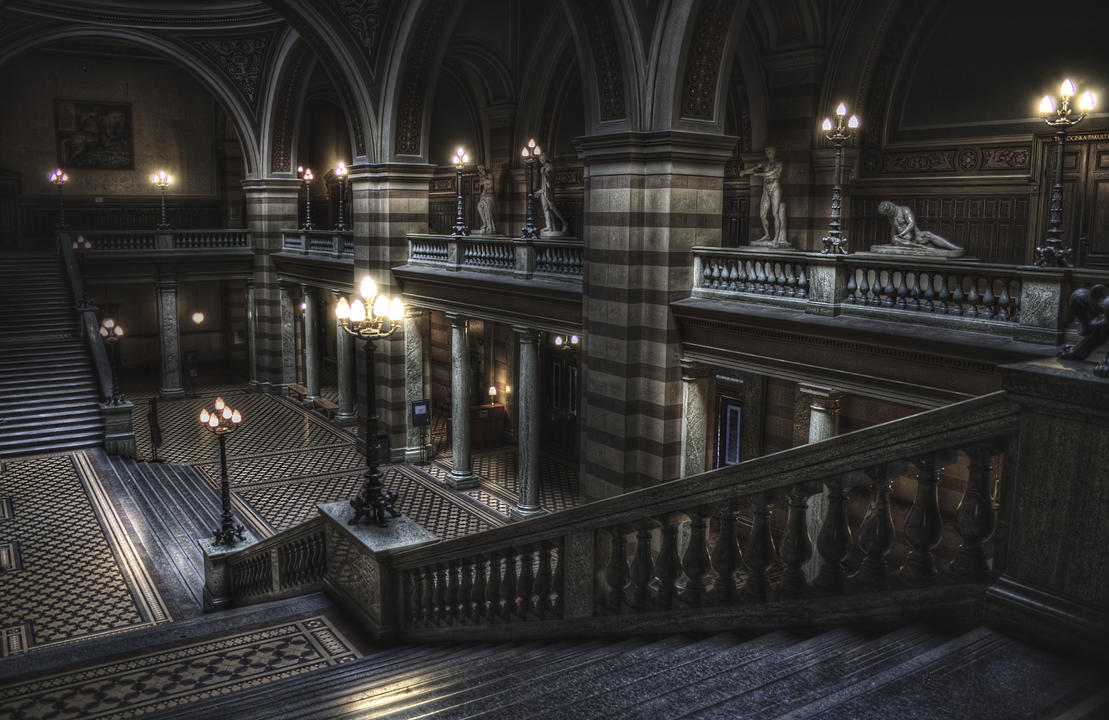
The weather can be used in a number ways and forms, most being misty or stormy. The convention of mist is often used to obscure objects by reducing the visibility to insert a terrifying person or thing. Storms are frequently used to accompany important events. There is also usually a damsel in distress who will, in some way, do something wrong in the eyes of the killer and then end up dying. Gothic Horror films usually use a style of medieval architecture and is usually set in medieval castles or churches. The setting is often dark, gloomy and full of secret chambers, dungeons and hallways.
Gothic fashion is a clothing style marked by dark, mysterious, exotic and complex features. A typical gothic fashion also includes a pale complexion with coloured black hair, black lips and black clothes. Both a male and female Goth would wear dark eyeliner and dark fingernail polish.
A Gothic hero is often an isolated figure who must restore himself to society. A figure of evil, who is sometimes has some kind of relationship with the supernatural, is often in opposition to the hero. Women also play a significant role in Gothic novels are they are depicted as victims of the tyrannical and evil men. Gothic hairstyles have striking shapes and a touch of romanticism, much like a well-cut-jet-black damask frock coat.


Character

Characters in Gothic Horror are normally the protagonist/hero, monster/antagonist, victim - who could also be the hero, damsels in distress, marvellous or mysterious creatures, monsters, spirits or strangers and characters with supernatural powers.
 

Camera Work

With camera work, films are more likely to use:
Birdseye/High Angle - As they make the figure underneath look more vulnerable and powerless.

Close Up - As they show the reactions on an actors/actresses face, This shot also shows the emotion and is also used to capture emotion within the scene.

Tracking or Panning Shot - These shots are used effectively in horror films to make out a character is being followed or watched. It could also establish a scene so the audience can see the full view of the shot.

Tilted Angle - Tilt shots add a lot of dramatic tension to shots, and could simplify a supernatural being, for example, pushing or moving the camera. Another use for the tilt shot is to act as though the camera is a victim on the floor, and you are therefore seeing what they are seeing.

Extreme Long Shot/Long Shot - This is a great scene to use to establish horror movies. This shot could put into perspective how deserted a town is.

Low Angle - Low angle shots are very powerful in a way they can emphasize just how scary or intimidating a villain is.

Hand Held Camera Shots - This shot is very often used in horror films to add a sense of reality. It makes the audience feel involved and adds to the horror of the scene as you feel like you are there.

Point of View Shot - This shot is taken from the point of view of the character. This is when the audience is able to see the film through the eyes of one character. This is popular in these types of movies as the audience becomes emotionally attached and more scared as the gun could be directly pointed at them for an example.

Zoom - This shot adds to the dramatic effect and creates element of suspense of fear as you don't know what you are going to see next. It could also be used to zoom into something you wouldn't of spotted before like a supernatural thing.


Editing

In Gothic Horror, you would usually have slow paced editing with lots of straight cuts and fade to blacks. This emphasises the fear and idea of gothic-ness.


Sound

For Sound, there would be a lot of eerie silences and non-diegetic stings throughout the film. There may also be some non-diegetic soundtrack to emphasise the sub-genre, this would also increase the fear in the audience.